
How many restrooms does a race need in Kokomo?
Runner count drives the math more than distance does. A typical race plan leans on the same logic as OSHA 1926.51(c), which sets 1 toilet for every 20 workers on a job site. Races are not job sites, but organizers use that ratio as a starting point and then add units at the start corral, where the crowd bunches up before the gun. For a 500-runner field, that usually means a cluster of standard units at the start, a second cluster at the finish, and single units at aid stations along the course. Check our how many porta potties do I need guide for a fuller breakdown by headcount. Every accessible cluster needs coverage too: ADA Standards 213.2 requires at least 5 percent of clustered units to be accessible, and never fewer than one. If your race draws wheelchair or handcycle athletes, put that ADA unit at the start and the finish, not buried mid-course. Kokomo events often run point-to-point rather than a loop, which changes where those clusters land. A pace group finish near a park pavilion needs its own bank of units separate from the start line, since runners will not backtrack half a mile to use one.
What does it cost to rent restrooms for a Kokomo race?
Race-day pricing runs by the event, not by the day, because setup, service and teardown all happen in a single push.
| unit | duration | low | typical | high |
|---|---|---|---|---|
| standard | event | 200 | 400 | 800 |
| standard | weekend | 125 | 250 | 400 |
| trailer | event | 2499 | 3500 | 3899 |
| ada | weekend | 199 | 240 | 300 |
A small 5K might run on standard units alone at event pricing. A marathon with a finish-line festival often adds a restroom trailer for VIP or medical staff, since a trailer gives real plumbing and a 60 to 70 gallon holding tank per stall instead of a single vault. See restroom trailer rental cost for stall-count comparisons, or check event restroom rental for pricing across formats beyond racing. Weekend races that span a Friday packet pickup through Sunday teardown often land closer to the weekend rate than the single-day event rate, so tell us your full footprint when you request a quote.
How do you set up restrooms along a race course?
Placement follows the route, the power needs and the ground. Aid stations and finish areas often run a light tower or a scoreboard off a generator, and if your course runs a temporary power pole out to a remote timing tent, brace it well before race morning. Knowing how to brace a temporary power pole matters here: a pole set on soft shoulder ground without side bracing can lean or shift once cables pull on it, especially with a timing mat crew running cable across the same stretch. Stake guy lines at three points around the pole base, angled away from foot traffic, and keep the cable runs clear of the accessible route so a wheelchair racer or a stroller has an unobstructed path, matching the 36 inch clear width called out in ADA Standards 403.5.1. Ground matters at the restroom cluster too: ADA Standards 302.1 calls for stable, firm, slip-resistant surfaces, which means avoiding loose gravel or a soft field edge that turns to mud during a spring race. If your course runs through a start area near Kokomo with a paved lot, that surface holds up better under 40 units and a service truck than turf does. For courses that finish near Cassville, 7.9 miles north of Kokomo, or loop out toward Hemlock, 7.1 miles southeast, plan your mid-course cluster around whichever crossing point runners pass twice, since a double-pass aid station covers two service needs with one set of units. Washing stations belong at any station handling food or medical supplies; a handwashing station with soap and towels satisfies 29 CFR 1910.141(d)(2), since hand sanitizer alone does not meet that standard. For races with a post-race cookout or paint station for finisher medals, note that OSHA 1926.51(f)(1) washing requirements apply specifically to paints, coatings, herbicides or insecticides, so a normal food table does not trigger that rule. Our porta potty placement guide covers ground clearance and delivery access in more depth.
How far in advance should we book race restrooms?
Book as soon as your course map and runner estimate are final, ideally 60 to 90 days out for a marathon-sized field. Race weekends compress demand across Kokomo, and popular Saturday dates fill first. Early booking also locks in unit counts before other weekend events grab the same inventory.
Can we get restrooms delivered before dawn for an early start?
Yes. Most marathons start before 7 a.m., so delivery typically happens the evening before. Tell us your start time and gate access when you request a quote, and we will schedule drop-off around packet pickup traffic and any road closures already in place.
Do we need restrooms at every mile marker?
No. Spacing every 1.5 to 2 miles works for most courses, with heavier clusters at the start, finish and any major aid station. A marathon with a mid-course spectator zone often benefits from an extra unit there instead of a strict mile-by-mile layout.
What about a finish-line VIP or media area?
A deluxe flushable unit or small restroom trailer works well for VIP tents, sponsors and media, since it offers a nicer interior than a standard unit without the footprint of a full trailer. Pair it with standard units for the general runner crowd nearby.
Can we add handwashing stations at aid stations?
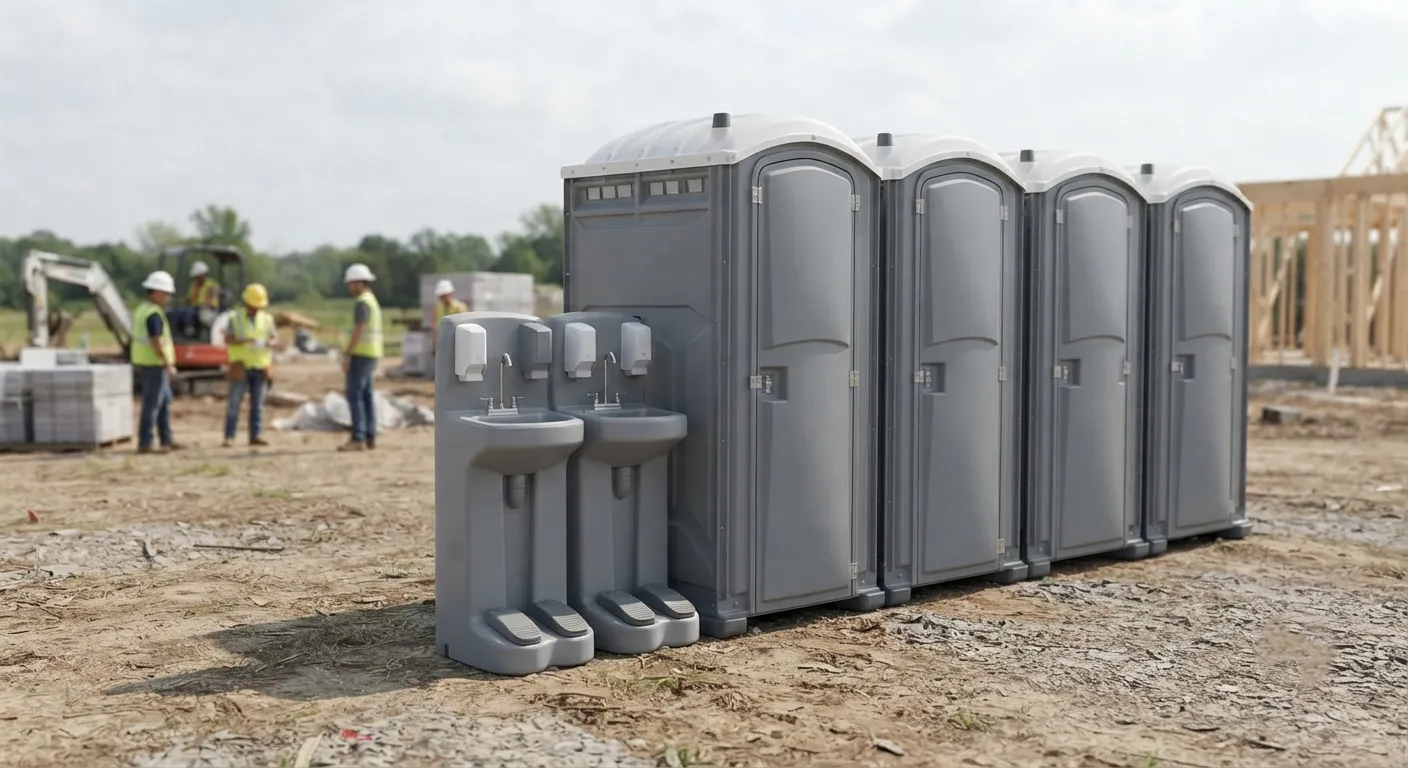
Yes, and most race organizers do. A portable sink or handwashing station at any aid station serving food or gels keeps volunteers and runners compliant with basic hygiene standards, and it pairs easily with a standard restroom cluster at the same stop.
Next step
Get a delivery date
Tell us the address, the dates and the headcount. We size the order and confirm the route.